
Study In Canada
World-Class Education in the Heart of Europe
About Canada
Canada consistently ranks among the best countries in the world, currently holding the top spot for quality of life. When you choose to study in Canada, you gain access to a world-class education led by top educators and academics, all within a vibrant and diverse cultural landscape.

Why Study in Canada?
World-Class Education in the Heart of Europe.
Discounts for International Students
Canada offers financial incentives and reduced tuition fees for students from abroad.
Scholarships, grants, and special programs make education more affordable.
Benefits from World-Class Education
Canadian universities consistently rank high globally.
Expert faculty, cutting-edge research, and diverse programs await you.
Work Experience After Graduation
Upon completing your studies, you can gain practical work experience.
Post-graduation work permits allow you to work in Canada and enhance your skills.
Possibility of Immigration
If you complete your degree in Canada and work for one year there, you can apply for a permament residence.
Turn your study journey into a lifelong adventure in Canada.
Live in a Bilingual Environment
Canada’s bilingual educational system (English and French) enriches your language skills.
Cultural immersion enhances your learning experience.
Work While Studying:
Modern amenities, sports facilities, and cultural events abound.
Enjoy a vibrant student life in Canada’s welcoming communities.
Required Documents
World-Class Education in the Heart of Europe
High School Transcript (Grades 9–12)
Grade 10 and 12 National Exam Certificates
English Proficiency Test (TOEFL, IELTS, or Duolingo*)
Some schools accept Duolingo or MOI (Medium of Instruction) certificate.
Valid Passport (minimum 1 year validity)
Recent Passport-Sized Photo
ID (if applicable)
CV (for some programs)
Essay (if required)
Awards & Certificates (if any)
3 Recommendation Letters
Sponsorship Letter + Bank Statements
Guardian Consent (for applicants under 18)
Medical/Immunization Certificates
Police Clearance Certificate
No study gap >5 years after high school.
If currently in 12th grade, submit:
School letter confirming expected graduation date.
Latest transcript.
High School Transcript (Grades 9–12)
Grade 10 & 12 National Exam Certificates
English Proficiency (IELTS/TOEFL/Duolingo*)
MOI certificate accepted by some schools.
Valid Passport (1+ year validity)
Passport-Sized Photo
ID (if required)
CV
Essay/Study Plan
Awards & Certificates (if any)
3 Recommendation Letters
Sponsorship Proof (Bank Statements)
Medical Certificate (if needed)
Police Clearance (for some schools)
Maximum 5-year gap after high school.
If graduating soon, provide:
School letter with expected graduation date.
Interim transcripts.
Bachelor’s Degree Certificate (or proof of pending graduation)
Official University Transcripts
English Proficiency (IELTS/TOEFL/Duolingo*)
Valid Passport
Recent Photo
ID (if applicable)
Resume/CV
Statement of Purpose/Study Plan
Publications/Awards (if any)
3 Recommendation Letters
Financial Sponsorship Proof
Medical Checkup Report
Police Certificate (if required)
Must have completed (or be finalizing) undergraduate studies.
Clear any unpaid university fees before applying.
Graduating students must submit:
University letter confirming expected graduation date & CGPA.
Invest in your future today.
Enroll in our Scholarship Application Course and take the first step towards achieving your academic dreams.
General Information About Studying In Canada
World-Class Education in the Heart of Europe
- Valid passport
- Proficiency in either English or French (with proof of passing prescribed language tests)
- Academic transcripts
Successfully applying to a Canadian educational institution requires understanding the specific requirements for schools and the courses they offer. Here are some common requirements applicable to all universities and institutions:
- Academic transcripts
Begin by ascertaining whether the institution you’re interested in is a Designated Learning Institution (DLI). Only DLIs can admit foreign students. You can find a list of DLIs on the official Canadian government website.
To gain entry into Canada, international students must prove proficiency in English or French. While IELTS is the preferred test for English proficiency, some institutions also accept scores from the Cambridge English: Advanced or TOEFL exams. Additionally, a few Canadian universities recognize English certificates from the Ethiopian Ministry of Education, confirming English as the medium of instruction in secondary schools in Ethiopia. To widen your options, consider taking English proficiency tests.
Once you’ve confirmed your interest, submit your documents and pay the application fee. The university will then send an acceptance letter, which plays a significant role in the subsequent formalities.
With an institution ready to admit you, it’s time to apply for the Canada Study Permit. You can apply online or visit your local visa application center. If applying online, ensure you have a valid credit or debit card for payment.
- Once your application has been processed, an immigration officer will decide on your study permit application. If accepted, start planning your travel to Canada. Your permit will have a start date, and you won’t be allowed to enter Canada before that date. Plan your travel accordingly.
You’ll need an acceptance letter from the Canadian educational institution where you plan to study.
- Online applicants should upload a copy of the information page of their passport during the application process.
- Once approved, you’ll need to send your original passport.
Write the name and date of birth of the applicant on the back of each photo.
- You must demonstrate that you can support yourself and any accompanying family members while in Canada.
- Acceptable forms of proof include:
- Proof of a student or education loan from a bank (if applicable)
- Bank statements for the past 4 months
- A bank draft that can be converted to Canadian dollars
- Evidence of tuition and housing fee payments
- The minimum funds required to support yourself as a student are $10,000 CAD plus your first-year tuition fee.
- You can also provide additional documents related to assets in Ethiopia, such as a vehicle registration certificate.
This letter helps the visa officer understand your goals and why you want to study in Canada. It also confirms your understanding of your responsibilities as a student.
- This certificate shows whether you have any criminal record.
- You can undergo the medical exam either before or after applying for a student permit.
- The examination ensures you are not inadmissible for medical reasons.
- The physical examination should be carried out at the following institution in Addis Ababa:
- IOM Addis Ababa
- Address: Bole Kefle Ketema, Woreda 03/05, Meseret Defar Road, Behind Millennium Hall.
- Study Permit Application Fee: $150 CAD
- Biometric Fee: $80 CAD
- You may also need to pay third-party fees, such as medical check fees and police clearance fees.
- A study permit allows foreign nationals to study at DLIs in Canada.
- Note that a study permit is not a visa; it does not grant entry into Canada.
- You may also require a visitor visa or an electronic travel authorization (eTA).
- If your study permit is approved, an eTA will be issued along with it.
- Typically, a study permit is valid for the duration of your study program, plus an additional 90 days. Use these 90 days to prepare to leave Canada or apply for an extension if needed.
During academic semesters: Maximum 20 hours per week
During scheduled breaks (summer/winter): Full-time permitted (40 hours per week)
On-campus employment: No hourly restrictions when working for the institution
To work off-campus without a separate work permit, students must:
Be enrolled full-time at a Designated Learning Institution (DLI)
Have commenced their academic program
Be pursuing a degree or diploma program
Possess a valid study permit with work authorization
Have obtained a Social Insurance Number (SIN)
Exceeding 20 work hours per week during active study periods constitutes a violation of study permit conditions. Such violations may result in:
Loss of student status
Ineligibility for future study or work permits
Potential removal from Canada
- Part-Time Positions:
Bookkeeper (16−16−22 per hour)
Customer Service Representative (15−15−18 per hour)
Office Assistant (17−17−20 per hour)
Restaurant Staff ($15 per hour plus gratuities)
- Seasonal Employment:
Summer break positions may include:Festival staff
Camp counselor
Freelance writing
Online tutoring
Data entry
Average part-time earnings: 35,100annually(35,100annually(18 per hour)
Entry-level positions: $29,250 annually
Experienced positions: Up to $68,250 annually
- Students may work full-time while awaiting PGWP approval if they:
Maintained off-campus work eligibility during studies
Submitted PGWP application before study permit expiration
Are in maintained status awaiting decision
Social Insurance Number application: Service Canada website
Post-Graduation Work Permit eligibility: IRCC website
Employment opportunities: Job Bank Canada
Student Dormitories
Typically furnished with access to campus facilities
Provides opportunities for social engagement and campus activities
Average cost: 3,000−3,000−7,500 CAD per academic year
Rental Apartments
Monthly rentals vary significantly by location
Cost estimates:
Shared room: Starting at $350/month
Private apartment: Starting at $2,000/month
Note: Prices are generally lower outside major urban centers
Recommendation: Contact local immigrant-serving organizations for housing assistance
Property Purchase
Requires mortgage approval from financial institutions
Minimum 10% down payment typically required
Approval based on income, assets, and credit history
Mandatory for all international students
Average annual premium: 600−600−900 CAD
Coverage and costs vary by province and provider
Food Costs
Average monthly grocery expenditure: $200 CAD
Additional costs for dining out or specialty items
Clothing Budget
Recommended allocation: <10% of net income
Cost-saving option: Second-hand stores for clothing and furnishings
Transportation
Public transit options: Buses, subways, commuter trains
Average monthly cost: $80 CAD
Alternatives: Cycling, walking, ride-sharing
Private transportation (car ownership) incurs additional costs
Costs vary significantly by city and lifestyle choices
Create a detailed budget accounting for all expenses
Explore student discounts and cost-saving measures
Consider part-time work opportunities to supplement income (within permitted hours)
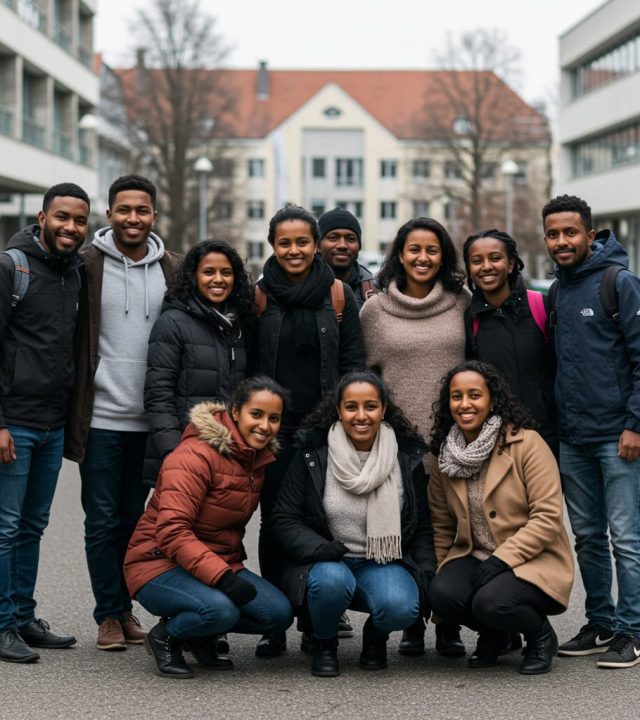
Student Life in Austria
A journey of growth, friendship, and academic excellence in Austria.
Bright Futures Abroad
Inspiring stories of Ethiopian students in Austria, embracing new experiences, achieving their academic goals, and building a brighter future in a diverse and dynamic environment.
New Horizons, Bright Futures
From Ethiopia to Excellence
REACH US
Get Direction the Event Hall
Street 140 Avenue, NY 90001 USA

inn eindhoven hotel
Elements users get 30 days of free access professional images sponsor.
Latest News
Subsribe To Our Newsletter
Stay in touch with us to get latest news and special offers.